
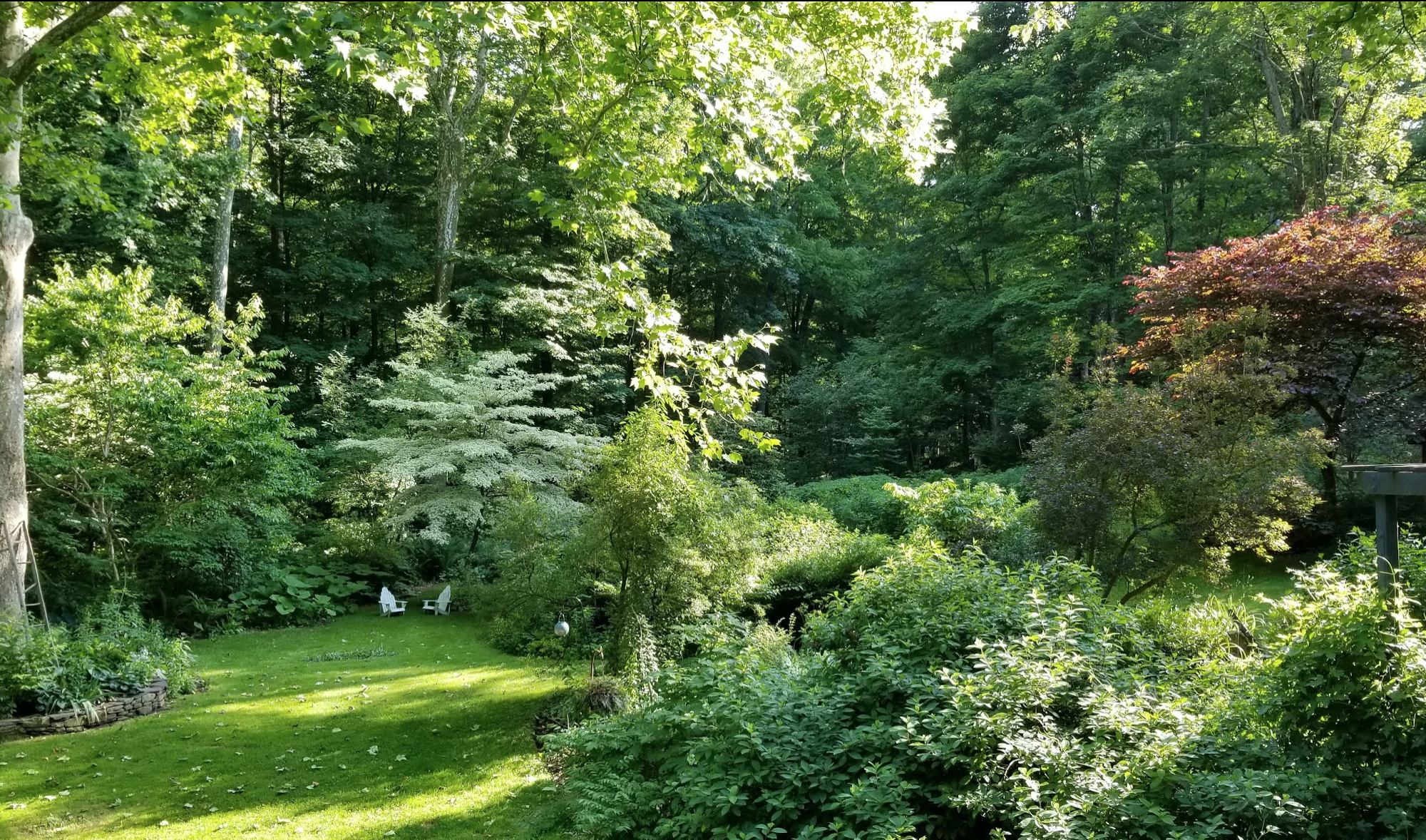

Situated along the Paunacussing Creek in Solebury Township, Bucks County, Pa., just down the hill a bit from the charming historical village of Carversville and just up the hill from the picturesque Delaware River village of Lumberville, Fleecydale Mill was not always the quiet retreat you see today. Take a look back at its origin story, provided by research from Gary Granzow, a neighbor, who researched the property for the Historic Carversville Society.
1789: The Fretz Mill Is Built

When it was initially built around 1789, what we know as “Fleecydale Mill” was called The Fretz Mill, and it is one of five mills built along the Paunacussing Creek in Solebury Township. While the population of the township was sparse during the periods of its operation, the demand for milled products grew very rapidly as the canals, and railroads were built, and the populations of New York City and Philadelphia grew feverishly. The mills furnished lumber, door and sash millwork, flour, corn meal, carded wool, clover, and guano (as fertilizer) to serve these markets. These products reached the surrounding farms, towns, and cities by a network of roads, but particularly by the Delaware River canal and the Belvidere Railroad, which was accessible by ferry and later the covered bridge that crossed the river in Lumberville, Pa.
‘The Fleecydale Manufacturing Company’
Jacob Fretz first bought the 29-acre property across the road and adjacent to Fretz Mill Road, in

1788 and a year later built a fulling mill on the Paunacussing Creek. Fulling is the process of cleaning raw wool to remove oil and lanolin using a product called Fuller’s Earth as a filter medium. The mill was used to make the Fullers Earth and to house the equipment. A portion of the creek was diverted upstream in order provide the water source for the millstones. Remnants of this redirected waterway can still be viewed in the topography of the property.
Jacob Fretz died in 1799 and the mill operations were continued by his son Phillip, who later in 1811 renamed the mill “The Fleecy Dale Manufacturing Company”. The property was reached only by what is now Fretz Mill Road as Fleecydale Road had not yet been extended to Lumberville and the road extending from Carversville, did not exist until the mill was built. So, Fleecy Dale Road was named for the mill when it was built. Philip Fretz extended the business to include the carding of wool (carding is the process of disentangling Fulled wool fibers to prepare wool for spinning) In 1819, he also added a clover hulling mill, advertising to “clean clover seed for one-tenth instead of one-eight–that is one bushel toll out of every ten bushels cleaned. In 1833, the clover mill was partially burned and was rebuilt.
Philip Fretz died in spring of 1851 and his will provided that his son Jacob and his friend Thomas Stradling “administer his property as co-executors for the benefit of his wife and children until such time as the property could be sold for good value.” Here is an excerpt from the advertisement in the November 4, 1851, Bucks County Intelligencer:
“…..No.1, A VALUABLE MILL PROPERTY, known as Fleecydale Mills, containing about 29 acres of land, 18 of which are Woodland, 4 of watered Meadow, and 3 of superior bottom land,….The improvements are a substantial MILL DAM and RACE, and a frame MILL HOUSE, of sufficient capacity for all of the machinery, consisting of CLOVER, FULLING, and CARDING MACHINES, with which a profitable business has been caried on during many years. It is propelled by the Paunacussing or Milton Creek, one of the most constant streams in the county, with a head and fall of 20 feet.”
The house was sold by the executors through a straw man, Joseph Dilworth, who on the next day in 1854 sold the property to Jacob FRETZ II for the same sum. ($4,000.00) This method of passing the property to Jacob II was probably chosen to avoid the lengthy probate process the state had suffered when Philip’s father, Jacob I, died.

Jacob Fretz II, like his father, was active in the milling business for an additional 40 years, milling plaster, spring wheat, wool carding, cake meal, lime phosphate, poudrette, and Peruvian guano. He sold the mill to Harvey Helsel in June of 1898, though the mill may not have been operational after the hurricane and flood of 1885. The valley had been heavily logged with very few trees remaining. (There are five trees on the current property which date to the early 19th century.) The storm of 1885 washed large amounts of soil down the creek, filling millponds and dams with mud from which most did not recover. The mill was converted to a residence in the 1930s.
A Bucks County Lifestyle
Now offered for sale, Fleecydale Mill is a beautiful 3.79-acre retreat with post-and-beam construction and expertly designed garden spaces providing beauty in all seasons. It offers 2,800 square feet of historical and comfortable living spaces with many updates, three bedrooms and, 2.1 baths. Its location, one of the most prized in the area, is even more inviting thanks to the many garden spots designed into the landscape. For a buyer seeking a peaceful spot in all seasons, this property is ideal. For more information or to schedule a visit, please contact Kevin Steiger, listing agent, at 215.519.1746, or steiger@kurfiss.com. The property is offered at $1,349,000.
 Kurfiss Sotheby's International Realty